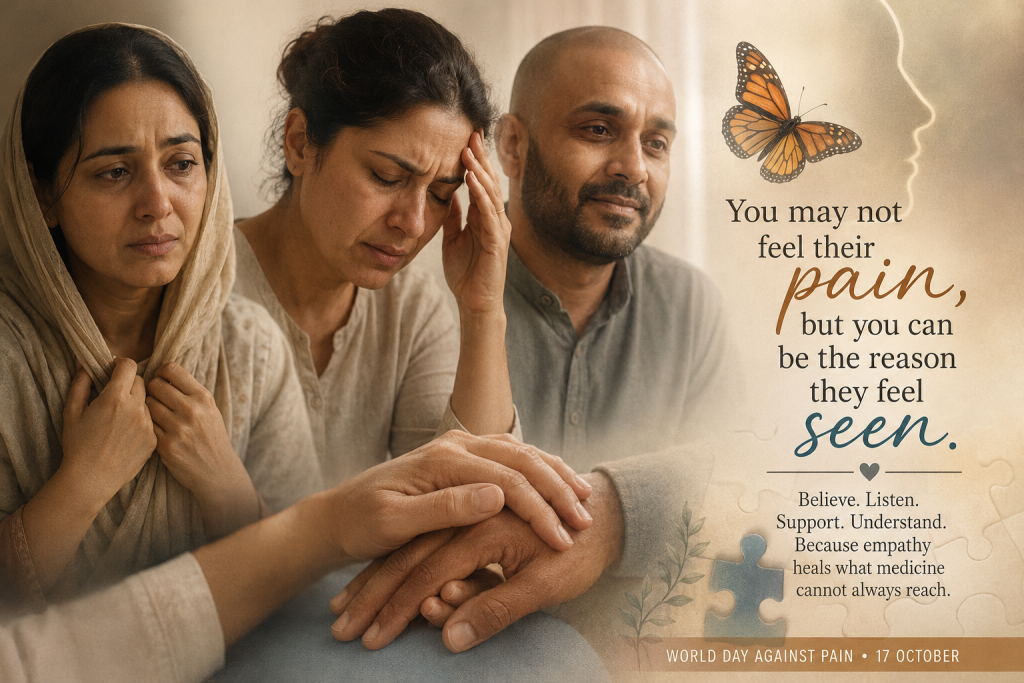
35-year-old Yasmeen sits across me in the chair at my clinic. She has her fingers wrapped around the fringe of her dupatta, her knuckles drained of blood, revealing the tension she is in. She has been holding too much, for too long.
“It took me an effort to come here and speak with you,” she says, tears brimming in her eyes.
I wait for her to complete her sentence.
“I thought you wouldn’t believe me either. It’s been so for so long now. I have stopped telling people about the pain I’m going through. It’s like I get hurt by the wind, the cold seeps into my bones. And this ache, this body ache doesn’t let go.” She pauses. “I have stopped explaining…”
I push a box of tissues in her direction. She pushes it back.
“I kinda feel like crying,” she smiles through her tears.
“They tell me I must pray more often, do yoga. How can you explain fire to someone who has never seen it?
I swear I burn from inside, Doctor. I really do, trust me…”
I nod, put my hand over hers.
“I believe you,” I tell her.
Her eyes widen a bit, and she manages a smile.
“I’m not lying,” she says, lowering her gaze.
Neha’s world, at 45, is built around her migraine. It is the fourth member in her home. On any normal day, her home is filled with kids’ laughter, the smell of desi ghee parathas, and her husband’s quiet presence.
But on days migraine hits, it all smashes in a millisecond.
“I can’t tell my kids to stop laughing. I can’t tell them that their laughter pierces through my head like a singeing iron rod. What kind of mother would say that? No one wants to hear me complain about my headache every week, but it is there. Despite so many medications, visits to so many hospitals, I still get it at times. I’m tired. I really am, doctor.”
I nod.
“You know the worst part?” she confides, her gaze locked on the bookshelf behind my chair.
“People talk behind my back. The other day I heard a neighbour saying, ‘All she has to talk about is her headache.’ I mean, what do they know of it? Am I causing it myself? It’s hard to keep quiet when your head is bursting as if glass shattered inside it. I’m not asking much. I just want to be understood,” she says.
Her sentence hangs mid-air between us.
To be understood. Yes, that’s right, I think.
Shoaib is a cancer survivor. He walks into my cabin with a smile on his face. He has sparse hair that tells me of the treatments he must have gone through ̶ to stay alive, to simply stay alive ̶ and I know he too, like Neha, isn’t asking for much.
“I survived, Doctor, but I’ll never get over the trauma. The pain is gone, but the shadow lingers. I wouldn’t wish this pain even on an enemy… And still, at times, I wake up drenched in sweat. I have nightmares. I feel the pain all over again. Everyone believes I am cured, but I know better. I still need help, Doctor. I am fighting a demon no one can see, but it’s there, and I face it every day. I need help.”
He chokes on his tears. Men aren’t supposed to cry.
The truth no chart can hold
These stories aren’t case files. They are the quiet, desperate soundtrack to the lives of people we love.
Chronic pain isn’t a symptom; it’s a rewrite. It’s your own nervous system- once a faithful messenger- now screaming into a faulty intercom, forever. When someone says they have a “low pain tolerance,” they’ve probably been tolerating a five-alarm fire for years while being told it’s just a spark. It’s not weakness. It’s exhaustion.
Why this day matters
The World Day Against Pain, observed globally every 17 October, was established to bring attention to those living with chronic and cancer-related pain ̶ pain that is often unseen, unheard, and underestimated.
It’s about looking at the Yasmeens, Nehas, and Shoaibs of the world and saying, “I see you. I may not feel your fire, but I see the sweat on your brow. I may not hear the glass in your skull, but I will turn down the lights. I may not feel the echo in your bones, but I will honour the memory you carry.”
It’s about making sure the first response to “I am in pain” is not a skeptical eyebrow, but an open heart.
How we can really help
Listen. Just listen. Don’t problem-solve. Don’t interrupt. Let their truth hang in the air, valid and unchallenged.
• Believe the invisible. Trust that if they say they are in agony, they are. Their body is their truth.
• Offer specific, small kindnesses. Not “Let me know if you need anything,” but “I’m going to the shop, what can I pick up for you?” or “I’ll handle the school run today.”
• Talk about it. Break the shame. Say “How is your pain today?” with the same gravity you’d ask about any other disease.
Because their pain is real. It’s in the worn-out edge of a kurta, the flinch at a sudden sound, the absent rub of a forearm.
It is real. And our belief is the first, most profound step toward healing.
If you know someone living with pain ̶ believe them. That’s where healing begins.