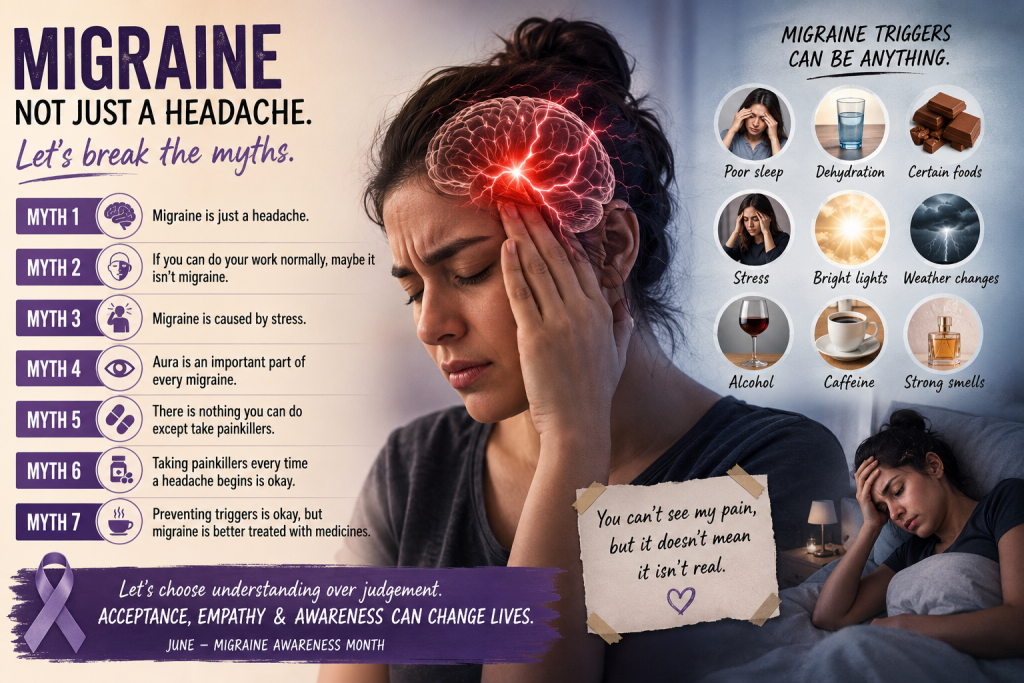
The month of June is dedicated worldwide to raising awareness about migraine and other headache disorders, so I decided to bust some common myths about migraine.
Myth 1: Migraine is just a headache.
Sorry, but it is not.
Migraine is a complex neurological disease. A simple headache doesn’t affect your vision. You don’t see zigzag lines. You don’t get blurred vision. You won’t hit another car while driving because you have “just a headache.”
Migraine can affect your vision as a wave of altered electrical activity slowly spreads through the visual cortex, the area of the brain where vision is processed. This is a part of migraine aura, and you can understand how frightening it can be.
A mother driving home with her child suddenly develops a migraine aura. Can you imagine what she goes through as the aura spreads, involving not just her sight but so many other parts of her body?
Sounds scary, doesn’t it?
And then what if she develops weakness on one side of her body; a condition called hemiplegic migraine?
Ever heard of it?
Migraine is not just a headache.
Myth 2: If you can do your work normally, maybe it isn’t migraine.
No, again.
Most people with migraine simply get better at pretending to be okay because no one wants to hear their tale of pain all the time.
They learn to function despite what they are going through.
Migraine exists on a spectrum. Some people may continue taking care of others while having a severe migraine attack because they don’t have another choice. That doesn’t mean their migraine isn’t bothering them.
Myth 3: Migraine is caused by stress.
No, it isn’t, though it may be worsened by stress.
Migraine itself is a very stressful condition. While some people with migraine may have a heightened response to stress, stress is not the cause of a migraine attack.
Dehydration, fasting, weather changes, loss of sleep, and certain foods can trigger an attack.
And yes, migraine can become worse with physical activity. That is why most migraine sufferers prefer a dark, quiet, cozy room away from loud noises during an attack.
Myth 4: Aura is an important part of every migraine.
It isn’t.
Only some people experience aura before an attack. Many migraines occur without any warning at all.
I have a patient whose migraine comes at odd hours when she isn’t even prepared for it. Her entire life has been disrupted because of this problem. Sometimes she has to cancel plans at the very last moment.
“I feel so helpless,” she told me once.
And I do understand how hard it can be.
Imagine getting ready for your best friend’s wedding. Everybody is excited. You have chosen your dress with care, spent hours at the tailor perfecting the look, and then suddenly you have an attack.
No, it isn’t that you cancelled the plan on purpose. Your migraine did.
Who wants to be nauseated and ready to vomit at the slightest provocation?
And what about the noise sensitivity? Or the strange smell of a perfume that felt perfectly fine just a little while ago?
That is what migraine does to you.
Myth 5: There is nothing you can do except take painkillers.
No.
Migraine treatment has progressed a lot.
Many people think migraine treatment means taking a tablet whenever the headache comes and then waiting for it to pass. But migraine treatment is much more than that.
Some patients improve with simple changes in their lifestyle and by understanding what triggers their attacks. Others need medicines to stop the headache once it starts. Some need preventive treatment because their migraines are occurring too frequently.
I have had patients who went from having multiple attacks a month to having only one or two. I have had patients who finally started sleeping better because they were no longer worrying about when the next migraine would strike.
Not every patient responds the same way, and sometimes it takes time to find the right treatment, but migraine is certainly not a condition where nothing can be done.
Our aim is simple; to reduce the frequency, severity, and impact of migraine on a person’s life.
Myth 6: Taking painkillers every time a headache begins is okay.
No.
It can lead to medication-overuse headache, where instead of decreasing the pain, the medication actually contributes to it, creating a cycle of continuous headaches that are not relieved by taking more tablets.
One of the first things we do in such patients is help them come off the excessive painkillers they are taking. This can sometimes cause a rebound headache, but it is an important part of treatment and a necessary step toward a headache-free life.
Myth 7: Preventing triggers is okay, but migraine is better treated with medicines.
This may be partly true, but understanding your triggers is an important part of migraine treatment.
Commonly reported triggers include missed meals, dehydration, poor sleep, oversleeping, stress, the “let-down” after a stressful period, hormonal fluctuations, bright lights, strong odours, weather changes, alcohol (especially red wine), excess caffeine or caffeine withdrawal, aged cheeses, chocolate, soy sauce, processed meats containing nitrates, monosodium glutamate (MSG), artificial sweeteners such as aspartame, and excessive screen exposure.
Migraine can be frustrating because the same trigger may not affect you every single time. A patient may sleep poorly one night and be absolutely fine, and on another day develop a migraine after the same lack of sleep. That is one of the reasons migraine can be so difficult to understand.
Triggers do not usually cause migraine on their own. Instead, they lower the threshold in a brain that is already susceptible to migraine.
That is why knowing your triggers matters.
Not because you have to live in fear of them, but because understanding them gives you one more way of fighting back.
Final Thoughts
The greatest burden of migraine is not only the pain itself; it is the misconceptions that surround it.
Every myth we leave behind brings us one step closer to better treatment, less stigma, and better lives for the millions of people living with migraine.
When it comes to migraine, facts are not just informative; they are therapeutic.
Do share this post with someone who needs to hear this. And if you have a loved one who suffers from migraine, perhaps this post will help you understand them a little better.
In the end, acceptance matters a lot to every person living with migraine.